Hydrogen Pre-Reduction and Sustainable Aluminothermic Smelting of Manganese Ore for Ultra-Low Carbon Ferromanganese Production
Refractory–Slag–Metal Interactions and Their Influence on Phase Evolution
We studied the interaction between Nchwaning ore before and after pre-reduction with various stable oxides. In this study, we investigated the effect of hydrogen pre-reduction of high-grade manganese ore on its smelting behavior and interaction with stable refractory oxides. Using Nchwaning ore (South Africa) as the feed, we showed that hydrogen pre-reduction effectively transforms higher manganese oxides (Mn₂O₃, Mn₃O₄) into MnO and reduces iron oxides to metallic Fe. This pre-reduction significantly altered the ore’s melting and wetting behavior on Al₂O₃, SiO₂, and MgO substrates.
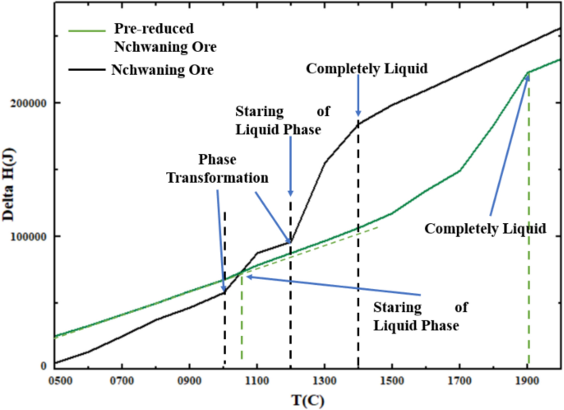
Figure 1- FactSage simulation showing the calculated melting point of raw ore and the pre-reduced ore
We observed that the H₂-pre-reduced ore exhibited a higher melting point (around 1544 °C on Al₂O₃) compared to the unreduced ore (~1485 °C), along with a lower contact angle, indicating improved wettability on Al₂O₃ and SiO₂ substrates. Interestingly, no full melting occurred on MgO, confirming its superior stability as a refractory for smelting of pre-reduced Mn ore. Detailed SEM–EDS analysis and FactSage thermodynamic modeling revealed diffusion of substrate oxides and the formation of interfacial phases such as MnO–MgO solid solutions, which governed melting and interfacial reactions. Overall, this work establishes a fundamental link between hydrogen pre-reduction, interfacial phenomena, and refractory performance—providing essential insights for the H₂-based pre-reduction and aluminothermic (HAlMan) process for sustainable manganese ferroalloy production.
Aluminothermic Smelting
In this study, we successfully developed and demonstrated a sustainable aluminothermic process (HAlMan route) for producing ultra-low carbon ferromanganese using hydrogen pre-reduced Nchwaning manganese ore (NPO) and aluminum as the reductant. The process yielded high-quality alloys containing 0.005–0.013 wt % C, 75–78 wt % Mn, and 18–22 wt % Fe, with Mn recoveries up to 93 % under optimized conditions (20 wt % excess Al and CaO/Al₂O₃ = 1.2). The accompanying slags were rich in mono-calcium aluminate (CaO·Al₂O₃, krotite) with minor gehlenite and tricalcium aluminate phases—offering potential for reuse as leachable, value-added by-products. During smelting, a clear evolution of the slag system from MnO–CaO to CaO–Al₂O₃ and of the metal phase from Al(–Fe) to Mn–Fe–Si was observed, driven by rapid interfacial reactions. Thermodynamic modeling further revealed a linear correlation between Mn and Si distribution ratios (L_Mn² vs L_Si), governed by the CaO/Al₂O₃ molar ratio. Increasing lime additions promoted tricalcium aluminate formation but also enhanced Al₂O₃ dissolution from the crucible (8 g → 13 g as CaO increased from 14 % to 21 %), slightly reducing Mn recovery. Overall, this work demonstrates a low-carbon, energy-efficient, and slag-recycling pathway for producing ultra-low carbon ferromanganese, providing a strong foundation for pilot-scale upscaling of the HAlMan process.
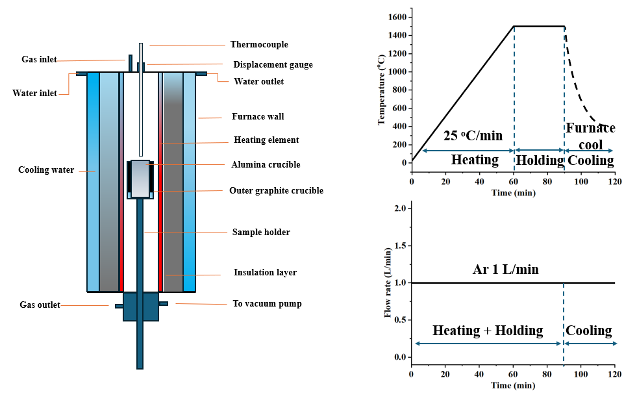
Figure 2: Schematic of the vertical tube furnace used for the experiment, b.) diagram for temperature profile and gas flow rate during the experiment.
Figure 3: Relationship between the distribution ratios of manganese and silicon when high-Mn Mn-Fe-Si alloy is in contact with calcium-aluminate slags.