The experimental work was focused on two representative manganese ores from the Kalahari Manganese Field:
United Manganese of Kalahari (UMK) ore – a high-carbonate, semi-oxidized manganese ore rich in braunite, kutnohorite, and hematite.
Gloria ore – a carbonate and oxide-bearing manganese ore with distinct reduction behavior compared to UMK.
Effect of Calcination on Hydrogen Prereduction
Calcination was applied as a pre-treatment step to selectively remove carbonates and hydroxides and to modify ore porosity prior to hydrogen reduction. Calcination at 900°C in air resulted in significant mass loss, decomposition of carbonate phases, and an increase in open porosity, particularly for UMK and Gloria ores.
Microstructural analysis confirmed enhanced mineral liberation and crack formation after calcination, leading to improved hydrogen accessibility. These structural changes translated into higher initial reduction rates and greater extents of reduction during subsequent hydrogen pre-reduction, especially at intermediate temperatures (700°C – 800°C).
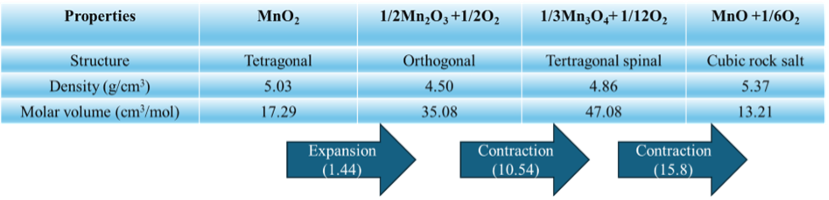
Figure 1. Structural, density, and molar volume changes associated with the stepwise reduction of manganese oxides (MnO2 → Mn2O3 → Mn3O4 → MnO), illustrating expansion and contraction effects that influence porosity development and hydrogen diffusion.
Experimental Methodology for Hydrogen Prereduction
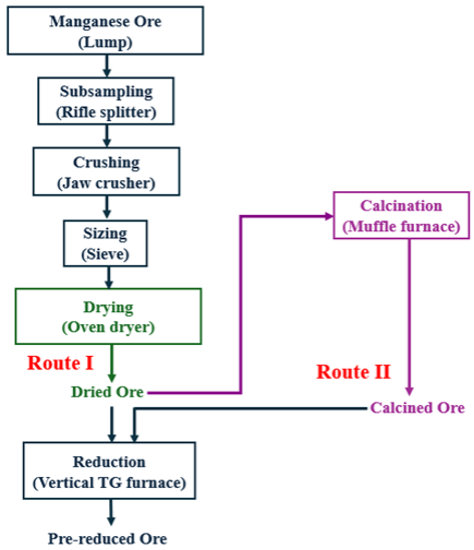
A systematic experimental methodology was developed to evaluate hydrogen prereduction behavior. Lumpy ores were crushed, sized, and dried prior to reduction. Two experimental routes were employed to isolate the effect of calcination on reduction behavior.
Figure 2. Experimental workflow and reduction routes used for hydrogen prereduction of manganese ores. Route I involves direct hydrogen reduction of dried ore, while Route II incorporates a calcination step prior to hydrogen reduction.
Isothermal hydrogen prereduction experiments were carried out in a vertical thermogravimetric furnace under 100% H2 at temperatures between 700°C and 900°C. Continuous mass-loss monitoring and gas analysis enabled quantitative evaluation of reduction kinetics and carbonate decomposition behavior.
Hydrogen Prereduction of UMK Manganese Ore
UMK manganese ore is a carbonate-rich and mineralogically complex feedstock, dominated by braunite with significant amounts of kutnohorite, calcite, and hematite. The high carbonate content leads to substantial CO2 release during heating, strongly influencing porosity development and gas-solid interaction during prereduction.
Hydrogen pre-reduction of UMK ore proceeds through a stepwise reduction of manganese oxides (Mn2O3 → Mn3O4 → MnO), while iron oxide (Hematite) are reduced to metallic iron at intermediate temperatures. Calcination prior to hydrogen exposure plays a key role by decomposing carbonate phases, lowering loss-on-ignition, and increasing open porosity, which enhances hydrogen accessibility to reactive oxide phases.
During reduction, carbonate decomposition is coupled with the reverse water-gas shift reaction, promoting more effective CO2 removal under hydrogen atmospheres. Kinetic analysis shows that dried UMK ore initially follows surface-reaction-controlled behavior, whereas calcined UMK ore exhibits higher reduction rates and lower apparent activation energies, indicating a shift toward diffusion-controlled reduction due to improved pore structure. At higher temperatures (900°C), partial sintering reduces porosity, increasing diffusion resistance at advanced stages.
Overall, these results demonstrate that hydrogen prereduction, combined with appropriate thermal pre-treatment, enables efficient conversion of carbonate-rich UMK ore to MnO, supporting its use in hydrogen-based low-carbon manganese processing routes.
Figure 3. Integrated schematic of hydrogen prereduction of UMK manganese ore, showing ore characteristics, drying and calcination steps, vertical TG furnace setup, and the stepwise reduction mechanism (Mn2O3 → Mn3O4 → MnO) under hydrogen.
Hydrogen Prereduction of Gloria Manganese Ore
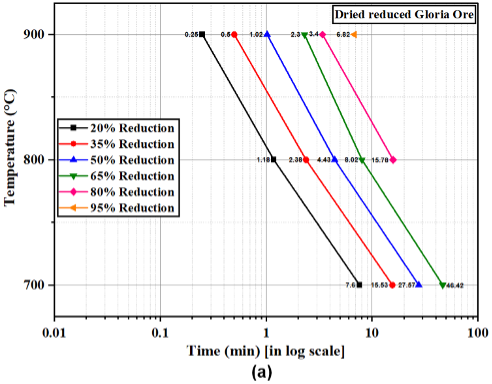
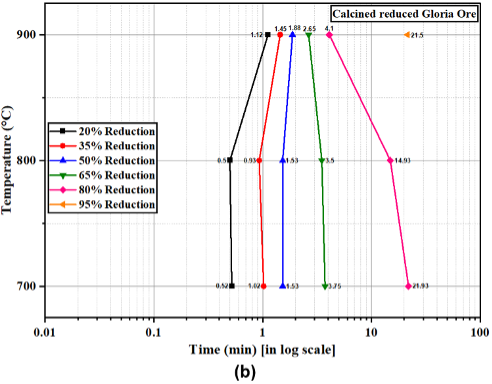
The hydrogen prereduction behavior of Gloria manganese ore was evaluated using Time-Temperature-Reduction (TTR) diagrams. This approach enables direct comparison of reduction efficiency as a function of temperature, time, and degree of reduction for dried and calcined ore.
For the dried Gloria ore (Fig. 4a), the TTR curves show strong temperature dependence, with slow reduction at 700°C due to chemically controlled surface reactions and internal structural effects. Increasing the temperature to 800°C – 900°C accelerates reduction.
Calcined Gloria ore (Fig. 4b) exhibits faster reduction at 700°C – 800°C, reflected by shorter reduction times, owing to carbonate removal and improved pore structure. At 900°C, partial densification and sintering reduce pore connectivity, increasing diffusion resistance and slowing high-degree reduction.
Figure 4. Time-Temperature-Reduction (TTR) diagrams for (a) dried and (b) calcined Gloria ore.
Kinetic Interpretation and Rate-Controlling Mechanisms
Kinetic analysis revealed that hydrogen reduction of the manganese ores (both UMK and Gloria) initially proceeds under chemical reaction control, followed by a mixed-control regime and finally diffusion-controlled behavior at advanced stages of reduction. Apparent activation energies indicating a mechanistic shift from surface-controlled kinetics in the dried ore to diffusion-controlled kinetics in the calcined ore Calcination reduced apparent activation energies and shifted the rate control toward diffusion-dominated mechanisms due to enhanced porosity.
Porosity Evolution and High-Temperature Densification of Gloria Ore
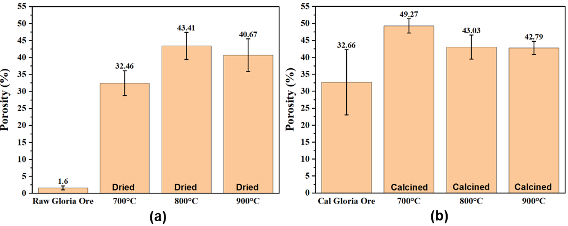
Figure 5 shows the variation of open porosity for dried and calcined Gloria manganese ore as a function of temperature. For the dried ore, porosity increases continuously with temperature due to carbonate decomposition and crack formation during heating except 900°C. In contrast, the calcined ore exhibits high porosity at intermediate temperatures (700°C – 800°C), followed by stabilization or a slight decrease at 900°C, indicating the onset of sintering and microstructural densification. This densification reduces pore connectivity and limits hydrogen diffusion at elevated temperatures, providing a direct explanation for the diffusion-controlled reduction behavior and longer reduction times observed for calcined Gloria ore at 900°C in the TTR and kinetic analyses. The porosity data therefore confirm the strong coupling between thermal pre-treatment, microstructural evolution, and hydrogen pre-reduction kinetics of Gloria manganese ore
Figure 5. Comparison of porosity in (a) dried and (b) calcined Gloria ore reduced at 700°C, 800°C, and 900°C.
Relevance to Hydrogen-Based Manganese Processing
The outcomes of Task 3.2 demonstrate that hydrogen prereduction to MnO is technically feasible for both UMK and Gloria ores. The findings provide a strong scientific basis for reactor modeling, process optimization, and integration of calcination with hydrogen reduction offers a promising low-carbon pathway for Mn-alloy production by enhancing reduction efficiency, lowering overall residence times, and decreasing CO2 emissions.
Reference
Sarkar, A., Tang, K., & Safarian, J. (2026). Hydrogen reduction kinetics of a high-carbonate manganese ore in raw and calcined forms under isothermal conditions. International Journal of Hydrogen Energy, 200, 152919. https://doi.org/10.1016/j.ijhydene.2025.152919.
Sarkar, A., & Safarian, J. Influence of calcination on the hydrogen prereduction behavior and kinetics of Gloria manganese ore for low-carbon manganese ferroalloy production. Manuscript in preparation.