A study by Mintek researchers, published in the journal Metals, examines the aluminothermic smelting of high-carbon ferromanganese slag in a direct-current arc furnace. The work brings together thermodynamic modelling, process simulation and experimental validation to investigate how manganese can be recovered from a manganese-bearing secondary material while managing energy use and the composition of the alloy and slag products.
What was the goal?
The research is relevant to HAlMan’s wider objective of developing sustainable routes to manganese and manganese alloys from primary ores and manganese-containing by-products. The Metals publication focuses on the aluminothermic treatment of HCFeMn slag and is one contribution to the wider research landscape rather than a report of the entire integrated HAlMan flowsheet.
What was done?
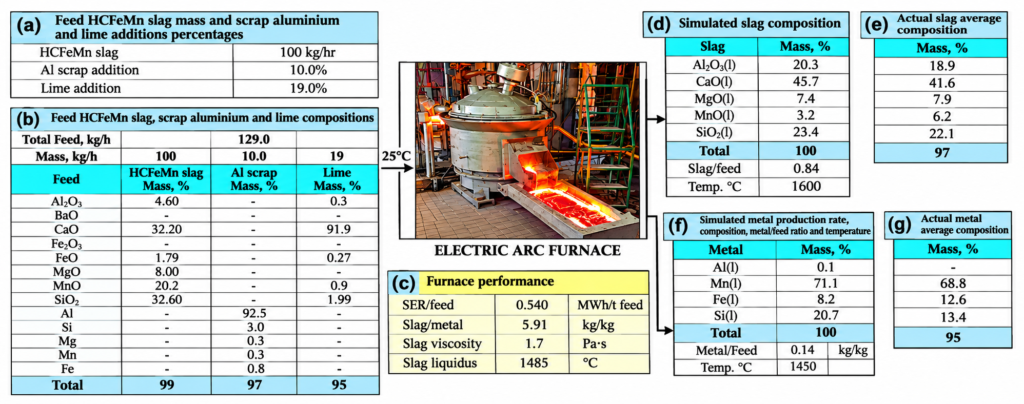
The team used FactSage thermodynamic software and Pyrosim, Mintek’s in-house sequential modular simulator, to predict equilibrium phases, energy balances and product compositions. The simulations were followed by aluminothermic smelting reduction of HCFeMn slag in a 200 kW DC (direct-current) arc furnace, smelting 2009 kg of slag with 202 kg of recycled aluminium scrap and 382 kg of burnt lime over 20 taps.
Figure 1. PyroSim simulation results for HCFeMn slag smelting: (a) feed HCFeMn slag mass and scrap aluminium and lime addition percentages; (b) feed HCFeMn slag, scrap aluminium and lime compositions; (c) furnace performance; (d) simulated slag composition; (e) actual average slag composition; (f) simulated metal production rate, composition, metal-to-feed ratio (kg/kg), and temperature (◦C); and (g) actual average metal composition. PyroSim-simulated values of slag
What were the results?
Under the conditions investigated, This pilot-scale study (TRL 6) validated the smelting–aluminothermic reduction of HCFeMn slag in a 200 kW DC arc furnace as a technically robust, materially efficient, and environmentally attractive route for the valorisation of an industrial metallurgical residue into a marketable Mn-rich alloy.
What happens next?
The value proposition depends not only on alloy recovery, but also on aluminium and flux consumption, energy requirements, product specifications, emissions and the potential to use or further process the resulting slag. The next steps for any potential industrial application include confirming performance across variable slag compositions, optimising reductant and flux consumption, assessing furnace productivity and alloy quality, characterising the by-product slag, and completing environmental and techno-economic evaluations. Further development would need to consider repeatability across different slag sources, reductant and flux consumption, furnace productivity, alloy quality, emissions, by-product management and a full techno-economic assessment.